Research project: Crip Time: Art of Impairment, Withdrawal, and Impatience
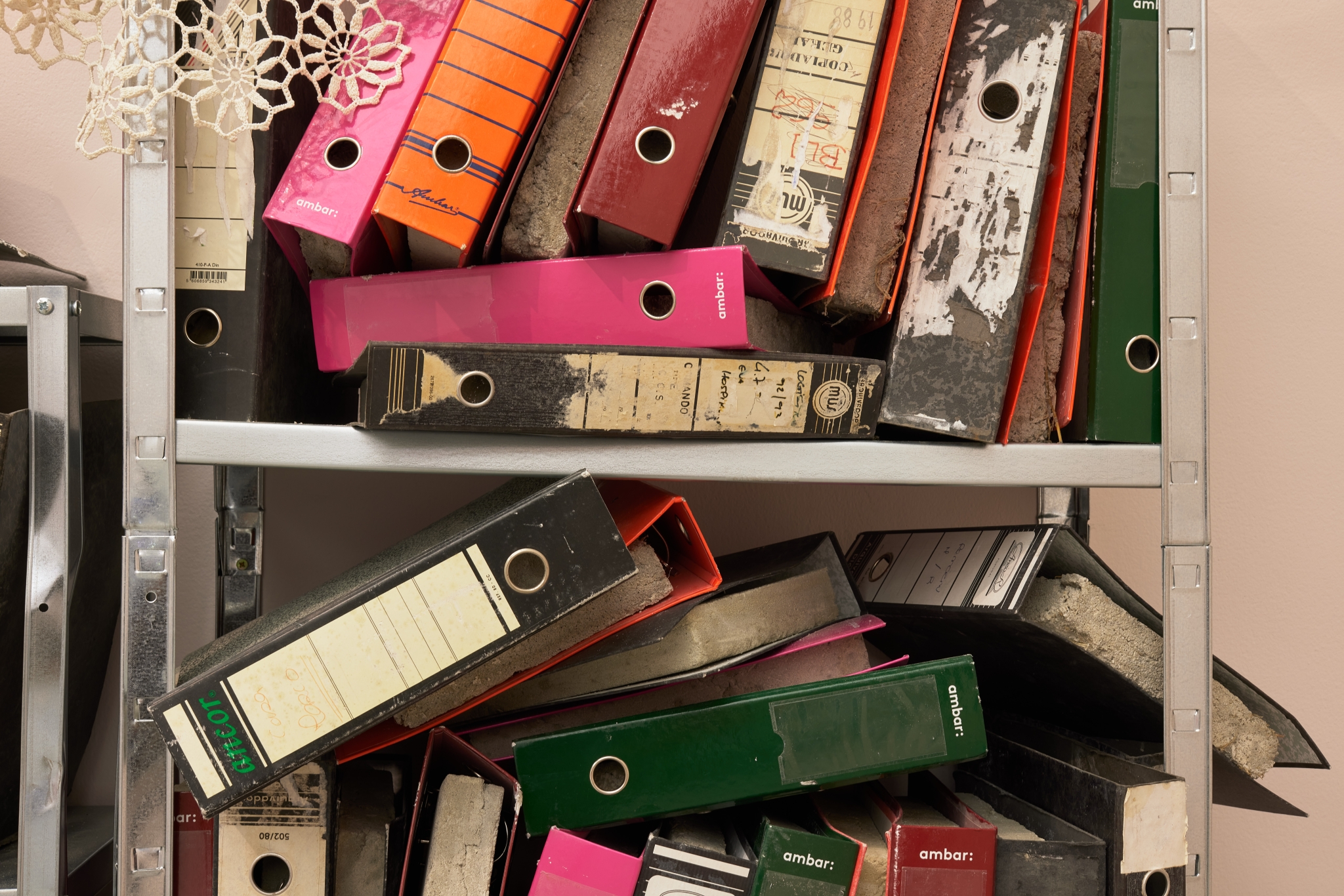
Jesse Darling, Epistemologies, 2022, Exhibition view: Turner Prize 2023, Towner Eastbourne, UK. Courtesy of the artist and Galerie Sultana © Tom Carter
During April 2024 to March 2027, O—Overgaden is hosting postdoctoral researcher Anne Kølbæk Iversen with the research project Crip Time: Art of Impairment, Withdrawal, and Impatience. Affiliated with O—Overgaden – Institute of Contemporary Art and the Department of Art History and Visual Culture at the University of Copenhagen, and funded by the New Carlsberg Foundation, the project looks closely at artistic articulations of impairment, vulnerability, and resistance, while examining O—Overgaden’s own “impairments” in the form of barriers to access.
The research project is inspired by art’s ability to develop new ways to express the experiences of vulnerability, isolation, and marginalization in relation to a given norm. It revolves around central questions including: What alternative identities and communities arise through variations from the normative body and mind? How can one bend one’s body to meet expectations and demands or, conversely, bend time and the surrounding world to meet a body with varying functions? What potentials and possible protests lie in withdrawal? Where is the transition between a treatment-ready patient and the impatient subject who rebels against diagnostic procedures and the objectification in medical language?
Foundational to the project is a conviction that artworks engaging with these questions provide an opportunity to understand vulnerability and dependency in other ways than the negative—beyond association with lack, loss, impairment, inhibition, or weakening. This approach is inspired by, among others, media historian and theorist Jonathan Sterne’s definition of “impairment” (see Diminished Faculties: A Political Phenomenology of Impairment, 2021) and feminist disability theorist Alison Kafer’s appeal to formulate alternative futures as a goal for a crip temporality (see Feminist, Queer, Crip, 2013).
At the same time, the project examines how art institutions like O—Overgaden can include care and accessibility in their practices—both in the production and dissemination of artworks and exhibitions.
The aim of the project is thus twofold: to understand, imagine, and value non-functional normative bodies, and life courses through an investigation of artistic expressions, in continuation of Kafer’s call for alternative futures, and to formulate proposals for how art institutions may facilitate less ableist ways of producing and presenting art. The temporal aspect and the so-called “crip time” are central prisms for inquiring into both the materiality of the works, and how institutions can implement increased flexibility and space for unpredictability in curatorial and organizational work. This duality is based on the premise that aesthetic negotiations of illness and disability, as well as their proposals for alternative futures, must be seen in relation to the organizational and institutional structures in which they are produced and presented.
The research project culminates in a group exhibition entitled IN PROTEST AND IN CARE curated by Anne Kølbæk Iversen. The exhibition will be presented both at O—Overgaden and in the Arne Jacobsen-designed pavilions in Enghave Parken from 28 August to 26 October 2026. Alongside the exhibition, workshops and seminars will be held in collaboration with external actors, which will shed light on issues of care, accessibility, and working conditions within the field of art and academia.
On 2 October 2026, a symposium will bring together presentations and talks by, among others, disability researcher Margaret Price alongside Danish-Swedish activist and author Emma Holten.